
Breaking the Myth:
How Bengaluru Emerged as India’s Safest City for Women
- Authored By
-
Ishita Gupta
Marketing &
Events Associate
Authored By
Ishita Gupta
Marketing & Events Associate
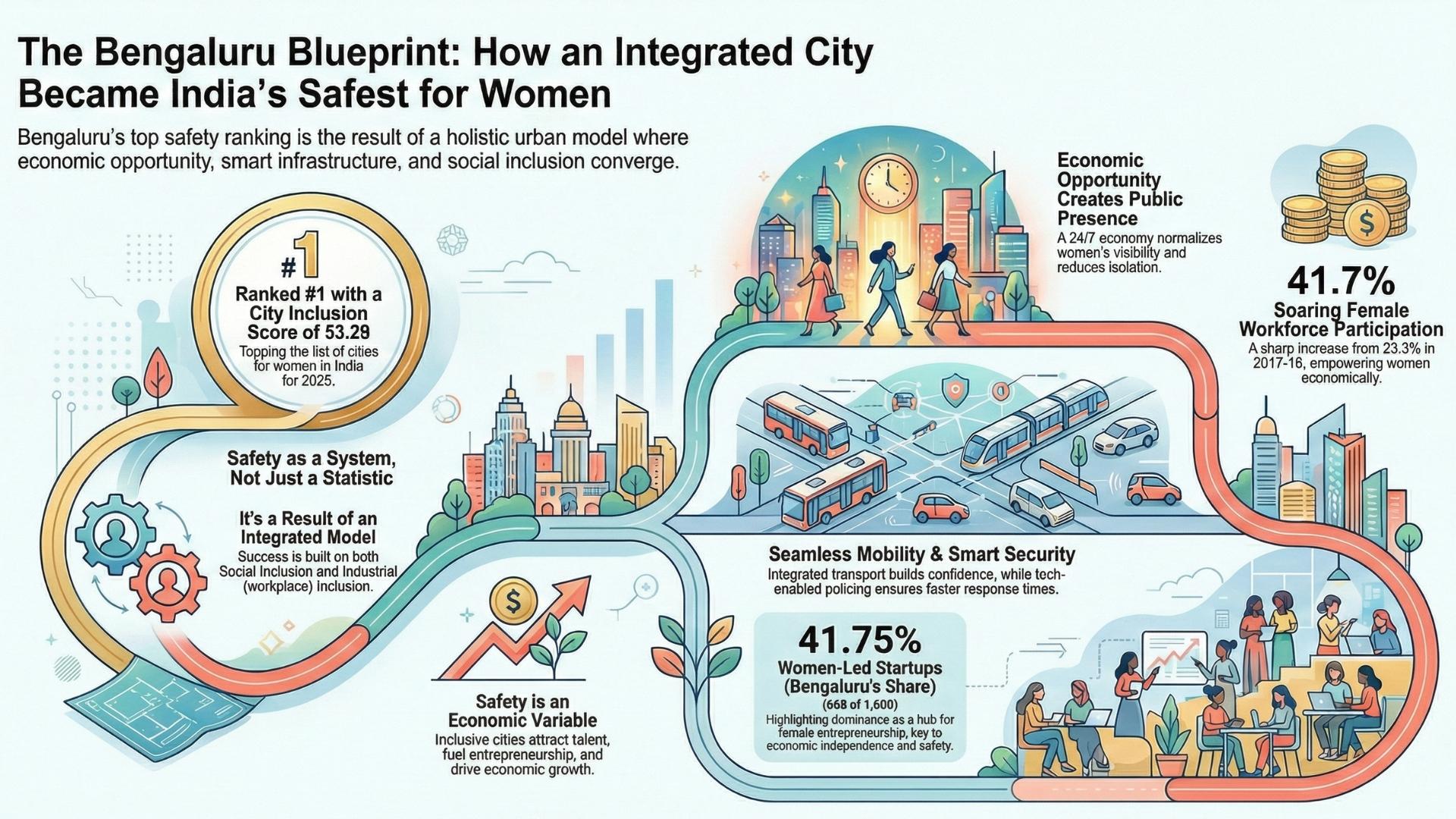
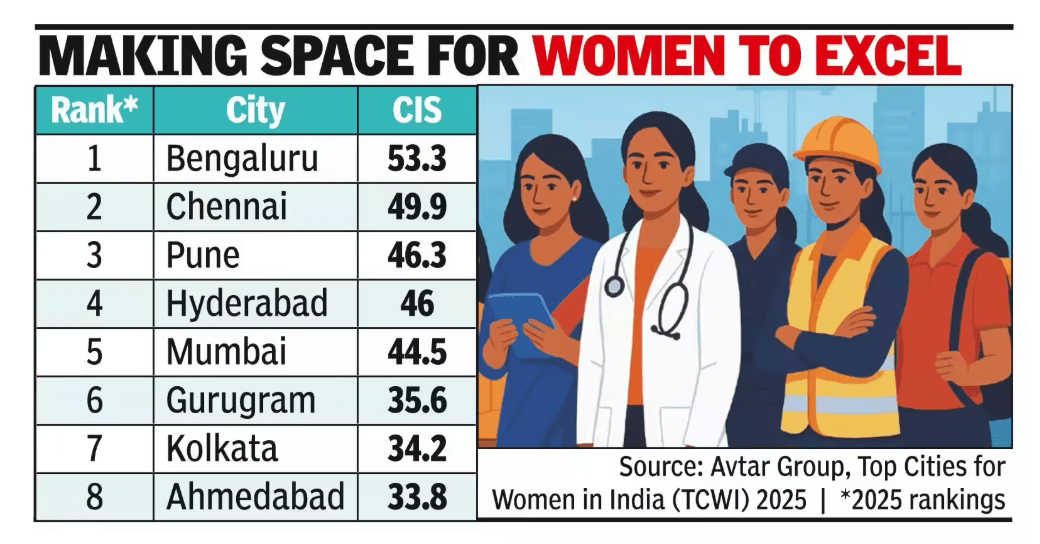
When Bengaluru was ranked as India’s safest city for women in 2025, the headline quickly drew attention and debate. Rankings often compress complex realities into a single number. But when viewed through a wider analytical lens, this recognition reflects something more structural than symbolic. It highlights how safety, employment, infrastructure, and inclusion converge to shape a city where women can participate fully in economic and social life. According to the Top Cities for Women in India (TCWI) 2025 report by Avtar, Bengaluru topped the rankings with a City Inclusion Score (CIS) of 53.29, outperforming cities such as Chennai, Pune, Hyderabad, and Mumbai.
My Perspective: Safety Is Not an Isolated Metric
Women’s safety is often discussed as a law-and-order issue. In reality, it is an outcome of how a city is designed, governed, and economically structured. Cities that rank well on safety typically do so because they perform well across mobility, employment, public infrastructure, responsiveness, and social norms.
Bengaluru’s position at the top reflects this integrated model; mainly being
- Social Inclusion Score (SIS) – liveability, safety, mobility, healthcare, education, and women’s empowerment
- Industrial Inclusion Score (IIS) – workforce participation, representation, career continuity, and women-friendly workplace ecosystems
Bengaluru’s leadership stems from its ability to deliver on both.
What Bengaluru Gets Right
Employment-First Urban Design:
Bengaluru’s ecosystem operates round-the-clock, driven by IT companies, startups, GCCs and industries. This sustained economic activity ensures continuous public presence across time zones, reducing isolation, one of the most significant risk factors for women’s safety.
High women workforce participation also normalises women’s visibility across roles, shifts, and geographies. Safety becomes an expectation, not an exception.
Industrial Inclusion with Real Career Enablement:
High scores in industrial inclusion are driven by women-friendly workplace policies, flexible/hybrid arrangements, leadership mentorship, and strong formal employment representation, because economic independence is one of the strongest enablers of personal safety and long-term inclusion.
Public Transport & Last-Mile Access:
The synergy between BMTC buses, metro expansion, and ride-hailing platforms fosters reliable transport and active public spaces. Women in Bengaluru report greater confidence travelling alone at night compared to many other metros, an outcome closely tied to reliable transport and active public spaces.
Technology-Enabled Policing and Response Systems:
Women help desks, tech-enabled community policing, integrated CCTV networks, and real-time command centres have reduced response times. Safety here is not passive surveillance, it is speed, coordination, and accountability.
Social Infrastructure That Supports Daily Life:
Access to healthcare, education, childcare, co-working spaces, community hubs, and safe recreational zones significantly improves quality of life. Bengaluru’s ecosystem enables women to balance professional growth with personal well-being.
Employment-First Urban Design:
Bengaluru’s ecosystem operates round-the-clock, driven by IT companies, startups, GCCs and industries. This sustained economic activity ensures continuous public presence across time zones, reducing isolation, one of the most significant risk factors for women’s safety.
High women workforce participation also normalises women’s visibility across roles, shifts, and geographies. Safety becomes an expectation, not an exception.
Industrial Inclusion with Real Career Enablement:
High scores in industrial inclusion are driven by women-friendly workplace policies, flexible/hybrid arrangements, leadership mentorship, and strong formal employment representation, because economic independence is one of the strongest enablers of personal safety and long-term inclusion.
Public Transport & Last-Mile Access:
The synergy between BMTC buses, metro expansion, and ride-hailing platforms fosters reliable transport and active public spaces. Women in Bengaluru report greater confidence travelling alone at night compared to many other metros, an outcome closely tied to reliable transport and active public spaces.
Technology-Enabled Policing and Response Systems:
Women help desks, tech-enabled community policing, integrated CCTV networks, and real-time command centres have reduced response times. Safety here is not passive surveillance, it is speed, coordination, and accountability.
Social Infrastructure That Supports Daily Life:
Access to healthcare, education, childcare, co-working spaces, community hubs, and safe recreational zones significantly improves quality of life. Bengaluru’s ecosystem enables women to balance professional growth with personal well-being.
Why This Matters Beyond Safety
Bengaluru’s ranking reflects more than safety, it signals economic strength. Safer, inclusive cities attract and retain global talent, enable 24×7 industries, reduce workforce attrition, fuel entrepreneurship, and strengthen startup ecosystems—ultimately driving sustained wealth creation and higher productivity.
The city’s status is highlighted by its support for women entrepreneurs, hosting 41.75% (668) of India’s 1,600 women-led startups. This ecosystem boosted the Female Labour Force Participation Rate (FLFPR) from 23.3% (2017-18) to 41.7% (2023-24), normalizing women’s visibility across all shifts.
“Safety is increasingly a strategic economic variable, influencing where companies invest and where professionals choose to live.”
Why This Matters Beyond Safety
Bengaluru’s ranking reflects more than safety, it signals economic strength. Safer, inclusive cities attract and retain global talent, enable 24×7 industries, reduce workforce attrition, fuel entrepreneurship, and strengthen startup ecosystems—ultimately driving sustained wealth creation and higher productivity.
The city’s status is highlighted by its support for women entrepreneurs, hosting 41.75% (668) of India’s 1,600 women-led startups. This ecosystem boosted the Female Labour Force Participation Rate (FLFPR) from 23.3% (2017-18) to 41.7% (2023-24), normalizing women’s visibility across all shifts.
"Safety is increasingly a strategic economic variable, influencing where companies invest and where professionals choose to live."
Safety is increasingly a strategic economic variable, influencing where companies invest and where professionals choose to live.
Final Thought: From Recognition to Responsibility
Bengaluru’s position as India’s safest city for women reflects a balanced urban model, where employment, infrastructure, governance, and social inclusion reinforce one another. The challenge now is not to defend the ranking, but to institutionalise the progress across the country.
Sustaining leadership will require deeper investments in last-mile connectivity, gender-sensitive urban planning, community engagement, and continuous workforce inclusion.
Bengaluru’s story suggests that when safety is embedded into how a city works, not treated as an afterthought, it becomes a powerful foundation for long-term, inclusive growth.
References
References
- IBT: Bengaluru tops list of safest cities for women in India
- Times of India: Bengaluru tops list of India’s most women-friendly cities for 2025
- PIB: Building Inclusive Workplaces- Ministry of Labour and Employment
- Number of Women Led Startups - Bengaluru Innovation Report